
My mother likes to remind us that knitting is really just about sticks and string. And crocheting pairs just one hook with that string which means it is even less complicated, right?
But the simplicity of our project gets thrown off the tracks right away if the yarn suggested in the pattern isn’t readily available. Even with on-line yarn shops you can still be out of luck if it is a discontinued line. And that happens more often than you might think as manufacturers try each season to entice customers to ever more exotic and luxurious new fibers, colors and spinning techniques. To make room for that to happen they often drop existing older lines.
Of course, you can always try to track down your yarn needs on Ravelry. There are many people trying to offload that last skein or two left over from a finished (or unfinished!) project. But you do need to be careful! There can be complications with how that yarn has been stored or whether there are pets, or even a smoker, in the house.
So, what to do if you can’t find the exact yarn called for in a pattern?
It is important to think of knitting and crocheting as the opposite of sewing. When sewing, you take fabric and cut it down to the necessary measurements to make your project. Your pattern will call out for a particular fabric to achieve the desired look of the finished project. If the pattern calls for a chiffon and you use a heavy velvet, you definitely won’t get the effect for which the designer was striving.
But, in knitting and crocheting you build your fabric and its dimensions as you go. And to get the look and feel of a specific fabric, knit and crochet designers use different fibers and weights (thicknesses) of yarn. The thickness of the eventual fabric and its drape or stiffness is decided by the density of your stitches which is determined by the weight of your yarn and size of needle or hook used. So, it is important to get as close to the designer’s original choice as possible.
How to find the right substitute yarn?
A good start is to find the weight of the yarn called for in the pattern because you are going to want your substitute to match that weight. In “yarn speak,” weight refers to the thickness of the yarn. This goes back to the days when yarn was nearly all spun to the same thickness and then sold by weight and not by yardage. If a thicker yarn was desired, you would ply multiple strands together. The thicker the yarn, the less yardage you will get for a standard 100 gram ball.
Most yarn producers in the United States use a numerical yarn-weight system. You might be familiar with a fingering weight yarn labeled as a number 1 and a worsted weight yarn labeled as a number 4. You can find the entire weight system at craftyarncouncil.com along with a host of other helpful standards.

However, yarns produced outside of the United States probably do not have those numerical designations on the label. Their labels give the gauge (stitches per inch or number of stitches over 4 inches/10 cm) and the recommended needle size to help knitters and crocheters determine the weight of the yarn. The recommended range of stitch gauge and recommended needles for each weight of yarn can also be found at craftyarncouncil.com.
[Originally, this post was going to contain the following information to help discover the weight of your yarn plus discuss the differences in fiber types. Fiber type is also something that can affect the final results of your fabric and eventually your final project. But, there is so much to share about that so I decided to do a separate post to give the subject is proper due. Watch for that post to come soon!]
How do you find the weight of a yarn?
Tip #1: Check Ravelry
Ravelry is a great source for finding the characteristics of different yarns. (Not familiar with Ravelry? We’ll have a post for new Ravelry users soon.) Not only will Ravelry give you the weight of the yarn that’s called for in the pattern, it will also give insight into other characteristics such as the fiber content, the construction of the yarn, the number of plies, and its proper care/washability.
Another great feature on Ravelry is the ability to see what other stitchers think about a particular fiber by clicking on the comments section when viewing a yarn. You can also check out the projects for a particular pattern to see what others have used and…. bonus …most people will even post a picture of their project so you can see how it actually turned out.
Tip #2: Not on Ravelry? Try Yarnsub.com
Some European yarns are not listed on Ravelry or the information provided might be a tad scanty. In this case you may need to visit the manufacturer’s website. Another source is yarnsub.com. I use this source quite a bit as it gives me insight into the likelihood of a good substitute I may already have or at least matching it to a yarn with which I am familiar.
Tip #3: What if you don’t know the yarn’s name? Use WPI!
This happens so often! You look through your stash and think you just might have the perfect substitute yarn. But a label can easily get misplaced in our growing collection of beautiful fibers. In this case, you can rely on the Wraps Per Inch (WPI) measurement to help. You can easily use any ruler you have at home for this handy technique.
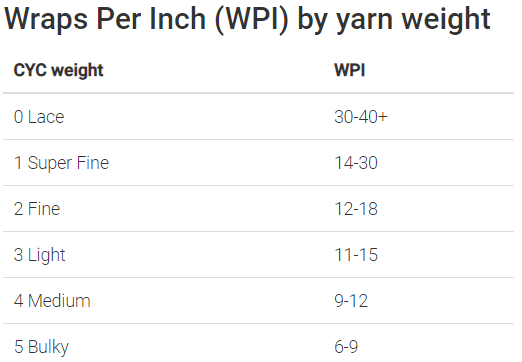
Take a strand of your yarn and wrap it around a length equal to one inch of your ruler. Make sure the strands are not wrapped too tight and are touching but not crowding or overlapping each other. Count how many wraps it takes to get one inch and then use the chart available from the craftyarncouncil.com website (shown) below to help figure out your yarn’s weight.
I’ll take a moment to mention that this type of measurement is how we end up in a yarn store looking as a yarn designated as a bulky even though it looks much thinner than any bulky we’ve ever worked with. If the yarn is wrapped so that only it’s “halo” (that’s the outer fuzzy part of fibers like mohair and alpaca) touches and not the center of the yarn, then it will read as a much bulkier yarn.
Tip #4: Go to your local yarn shop!
Really, that is your local yarn shop’s strength. Call it a super power even! They can help in so many ways such as showing how certain yarns have been worked up in other projects or even what successes other customers have had with the pattern and/or yarn you’re considering. And, if they are familiar with your level of ability, they can even help steer you away from potential problems. I’ve had customers walk in with one particular goal in mind and end up leaving with something else entirely! And best of all, they were very happy with the results and that is what is most important. A happy knitter or crocheter means there’s been project success and that’s what we are all about! J




 She Sells Yarn and More
Leave a reply to horsecrazy98 Cancel reply